


In today’s complex and competitive world, where every millimeter and every microsecond holds critical importance, advanced industries are more dependent than ever on precision, reliability, and stability in their production processes. From manufacturing ultra-precise components in aerospace to ensuring quality in the production of medical equipment and automotive manufacturing, the foundation of all these successes rests on the accuracy of testing and measurement. Testing and measurement devices serve as the eyes and ears for engineers and technicians, ensuring correct functionality, material quality, and compliance with standards. These tools not only detect and rectify potential errors but also significantly contribute to innovation, continuous improvement, and increased productivity.
Why are Testing and Measurement Vital in Modern Industries?
Modern industries face numerous challenges:
- Product Quality: Ensuring that the final product meets all technical specifications, quality standards, and customer requirements. A small measurement error can lead to mass production of defective products, irreparable costs, and damage to brand reputation.
- Safety: In industries such as medical, aviation, and automotive, the slightest technical defect can have catastrophic consequences. Accurate testing and measurement devices guarantee the ultimate safety of the product and its users.
- Performance and Optimization: Advanced devices allow engineers to precisely monitor equipment operating parameters and, by optimizing them, reduce energy consumption, wear and tear, and maintenance costs.
- Compliance with Standards: Many industries are required to adhere to national and international standards (such as ISO, ASTM, ANSI). Standardized testing and measurement devices are the primary tools for proving compliance with these standards.
- Innovation and Research & Development (R&D): In the R&D process, creating new products requires precise measurements to evaluate the performance of prototypes, identify strengths and weaknesses, and improve designs.
Main Types of Testing and Measurement Devices and Their Applications
The field of testing and measurement is vast, encompassing dozens of different instrument categories. Here, we will touch upon some of the most common and important ones:
Dimensional Measurement Tools:
- Caliper (Vernier Caliper / Digital Caliper): Used for precise measurement of length, external and internal diameter, and depth of objects. Widely utilized in machine shops, quality control, and assembly.
- Micrometer: Offers much higher accuracy than calipers and is used for measurements with very low tolerances, such as sheet metal thickness, wire diameter, or precise dimensions of machined parts.
- Squares and Rulers: Basic tools for linear measurement and angle verification.
- Coordinate Measuring Machine (CMM): Advanced, automated devices that use touch-trigger or laser probes to measure and model the three-dimensional dimensions and shape of complex parts with micrometer accuracy. These machines play a vital role in the quality control of complex components in industries like automotive and aerospace.
Electrical & Electronic Measurement Devices:
- Multimeter: A versatile tool for measuring voltage (AC/DC), current (AC/DC), and electrical resistance. It’s an integral part of any electronics or electrical toolkit.
- Oscilloscope: A key instrument for observing and analyzing the waveform of electrical signals over time. Essential for troubleshooting electronic circuits, analyzing signals, and understanding circuit behavior.
- Signal Generator: Used to produce electrical signals with desired frequencies and waveforms for testing and simulating circuit operating conditions.
- Cable and Network Testers: Used to check connections and identify open circuits or short circuits in cables and computer networks.
Temperature & Humidity Measurement Devices:
- Thermometers: Available in various types, from contact thermometers (thermocouple, RTD) to non-contact thermometers (infrared, pyrometer). Accurate temperature measurement is crucial in industrial processes where temperature is a key parameter (e.g., furnaces, production lines, food processing).
- Hygrometers: Used to measure the amount of water vapor in the air, which is important in industries such as pharmaceuticals, food production, and warehouse environmental control.
- Thermal Imaging Cameras: These devices capture thermal distribution on surfaces, enabling the identification of overheating spots in electrical or mechanical equipment, heat leakage in buildings, and even structural defects, all without physical contact.
Pressure & Flow Measurement Devices:
- Pressure Gauges: Used to measure the pressure of liquids or gases in piping systems, tanks, and production lines.
- Flowmeters: Used to measure the flow rate (volume or mass per unit time) of liquids or gases in pipelines. This measurement is critical for process control, consumption calculation, and ensuring proper material transfer.
Materials Testing Equipment:
- Hardness Testers: Measure a material’s resistance to scratching or indentation. Used in quality control for metallic and polymer raw materials.
- Tensile Testers: Measure a material’s tensile strength, yield point, elongation, and elastic modulus. Widely used in the metallurgical, plastics, and composite industries.
- Impact Testers: Evaluate a material’s resistance to impact and shock, which is particularly important under specific operating conditions (e.g., low temperatures).
The Role of Companies like Nikan Electronic Shahvar in the Industrial Ecosystem
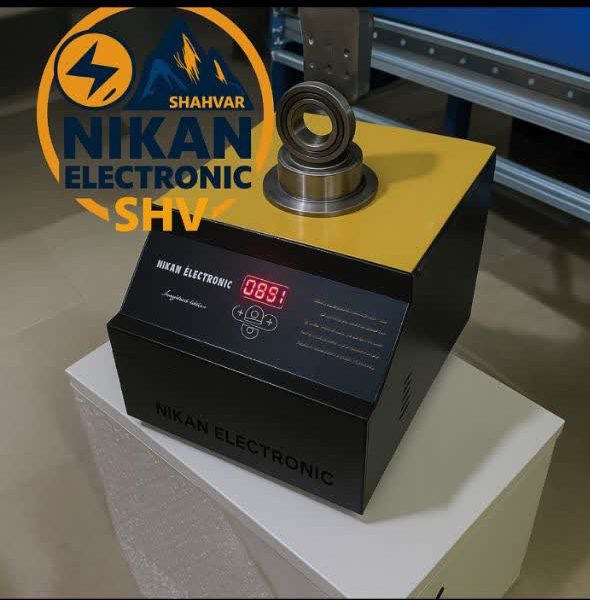
Although Nikan Electronic Shahvar may not directly specialize in manufacturing all these testing and measurement devices, a deep understanding of the needs of the industries that utilize these tools allows the company to offer solutions that indirectly contribute to enhancing the overall precision and efficiency of industrial processes. For instance, the induction heating devices manufactured by this company themselves require precise control of temperature and time. Therefore, the quality and accuracy of these heaters, in turn, influence the quality of subsequent processes that rely on precise measurements.
Furthermore, many industries require the accurate calibration and maintenance of their testing and measurement devices. Ensuring that a temperature sensor, a pressure gauge, or a caliper displays correct and reliable values is itself an important industrial process. Companies involved in the manufacturing or repair of industrial equipment play a key role in maintaining the accuracy and reliability of these critical instruments.
Conclusion: Investing in Precision is Investing in the Future
Ultimately, testing and measurement devices are not merely measuring instruments; they are considered the backbone of quality assurance, safety, and innovation in modern industries. Investing in the purchase of precise devices, training personnel for their correct use, and fostering a culture of accuracy within the organization are fundamental steps towards long-term and sustainable success in today’s competitive world. While the path to absolute precision may be challenging, the continuous effort to approach it guarantees quality, reduces costs, and increases customer satisfaction. Leading industries are those that understand the importance of these tools and consistently strive to upgrade their testing and measurement capabilities.

No comments yet.